
Day 11: Exploring Tuples and Sets
Python is the language of data scientists so more data set types.

Welcome to Phase 2, where we dive deeper into Python data structures! Today, we're learning about two new data structures: Tuples and Sets.
Tuples
A tuple is an ordered collection of items that is immutable, meaning once it's created, you cannot modify its elements.
Creating Tuples:
Here's how you create a tuple:
# Tuple creation
colors = ("red", "green", "blue")
print(colors)
Accessing Elements:
Access elements by index:
print(colors[0]) # Output: red
Why use tuples?
Performance: Slightly faster than lists.
Immutability: Ensures the data remains unchanged, which is useful for data integrity.
Mini-challenge:
Create a tuple named fruit containing three fruits and print each fruit using a loop.
Sets
A set is an unordered collection of unique elements. It automatically removes duplicates and is useful for membership tests and removing repeated items from lists.
Creating Sets:
Here's a basic example:
# Set creation
unique_numbers = {1, 2, 3, 2, 1}
print(unique_numbers)  # Output might be: {1, 2, 3}
Checking Membership:
Check if an item exists in a set:
print(2 in unique_numbers) # Output: True
Adding and Removing Items:
unique_numbers.add(4)
unique_numbers.remove(1)
print(unique_numbers)
Mini-challenge:
Given the following list, remove duplicates by converting it to a set:
animals = ["dog", "cat", "bird", "dog", "cat"]
Print the resulting set.
Leveraging AI
Use your AI assistant (ChatGPT or GitHub Copilot) to:
Generate exercises around tuples and sets.
Explain any errors or confusion you encounter.
Explore real-world use cases where tuples and sets are beneficial.
My Prompts
Here are some prompts I asked during today's learning session and helpful AI replies:
Prompt
"Explain the syntax differences between Python data types."
AI Reply
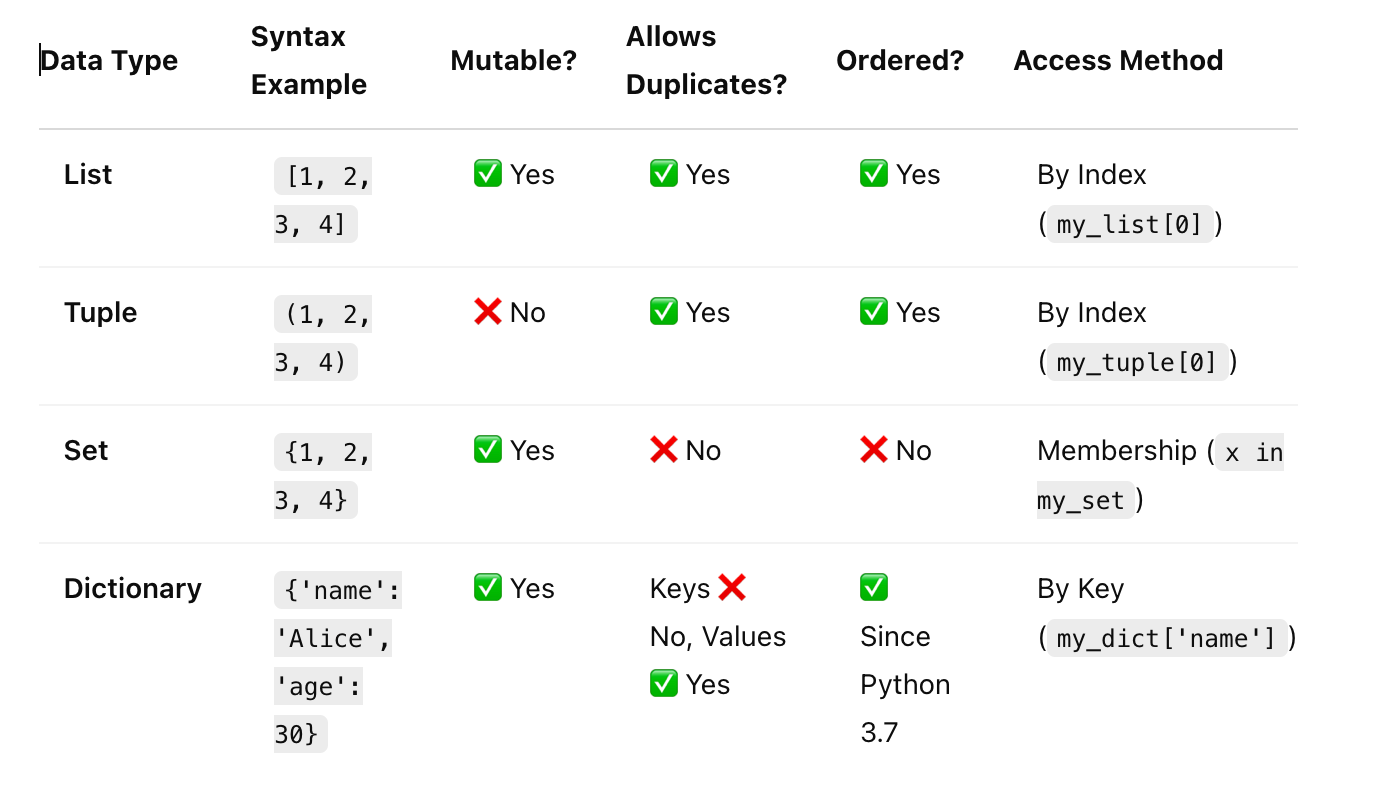
Reflection:
How might immutability (like with tuples) be beneficial in programming?
What are some practical situations where using a set could simplify your code?
Great work today! Tomorrow, we'll explore advanced dictionary operations to further enhance your coding toolkit.